By Munesu Shoko. Published courtesy of Quarrying Africa www.quarryingafrica.com
In the past few years, the global ADT market has shown resilience, with strong demand from some of the major equipment markets. According to Castle, although some of the major global markets are showing a decline, the ADT market remains strong and consistent with pre-COVID levels. Generally, he says, the boom, which was experienced in 2021 as governments announced infrastructure projects to stimulate economic recovery post-COVID, started phasing out around 2023. Since then, the market has been reverting to its regular size and demand has been tracking those pre-COVID levels.
“Over the past decade, the global ADT market has averaged around 8 000 units per year. It peaked in 2023 when it reached about 12 000 units, before resizing to about 9 000 units last year. The United States is consistently the largest market, constituting around 50% of the total market, followed by Western Europe and Africa, which alternate between second and third place, and are around low to mid-teens each, depending on the year,” explains Castle.
International market drivers
The major driver in the biggest ADT market, the United States, is construction – new infrastructure builds and maintenance thereof – thus driving optimal new machine replacements. “In our experience, customers in first-world countries generally replace their machines earlier than their African counterparts, so there is always demand for new machines in those developed markets,” says Castle.
Apart from construction, there is also notable demand from the mining sector, where ADTs are often deployed in the early phase of mine development and for the maintenance of current operations. “I would estimate that about 10% of demand for ADTs in the United States is attributable to mining,” adds Castle.
The climate in Western Europe, he adds, is a huge factor in why ADTs are the preferred truck in mining and construction. In the UK, the largest Western European market, the ADT is the truck of choice due to its ability to navigate the often wet, muddy and soft underfoot conditions resulting from the UK’s frequent rainfall.
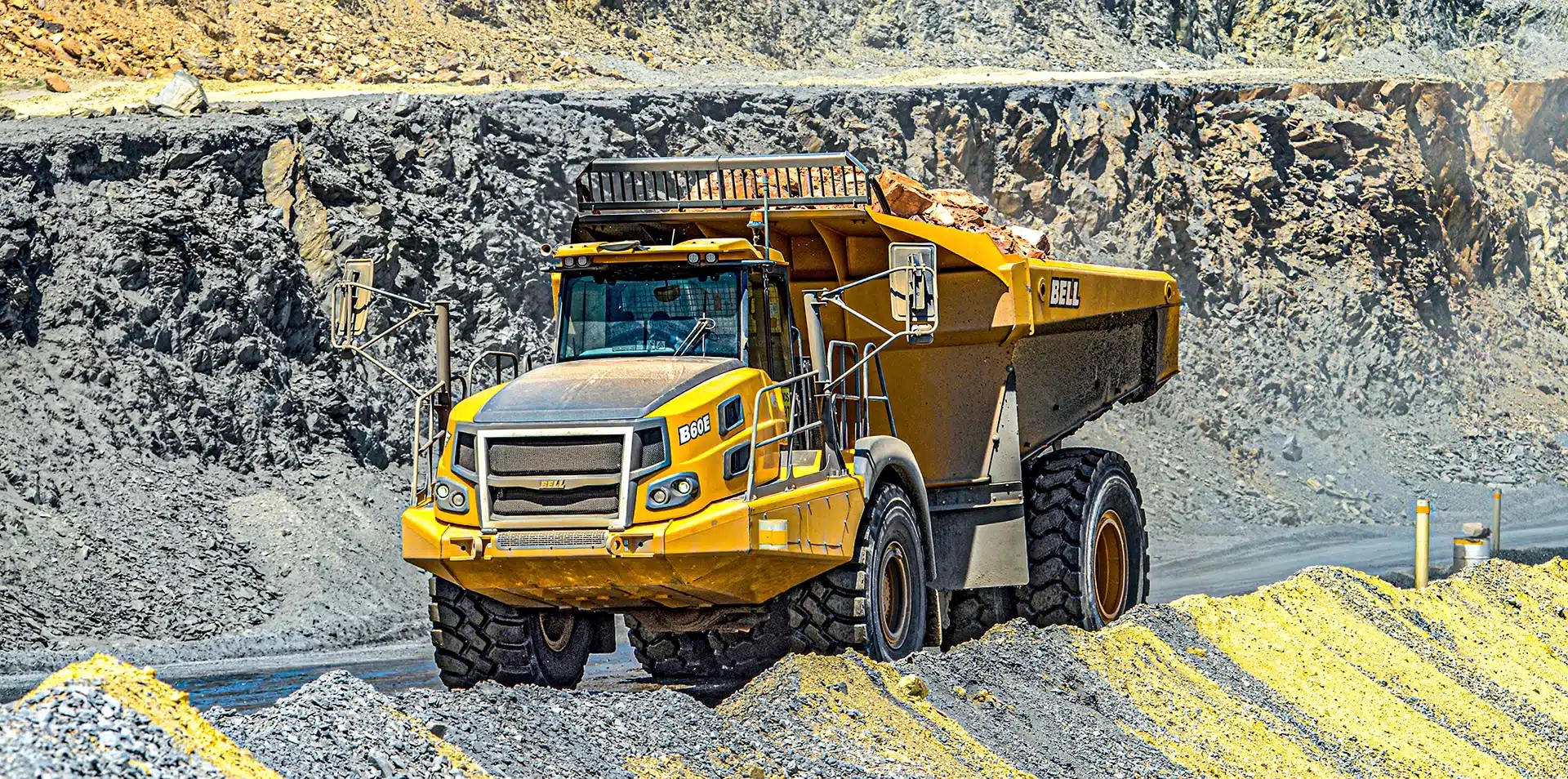
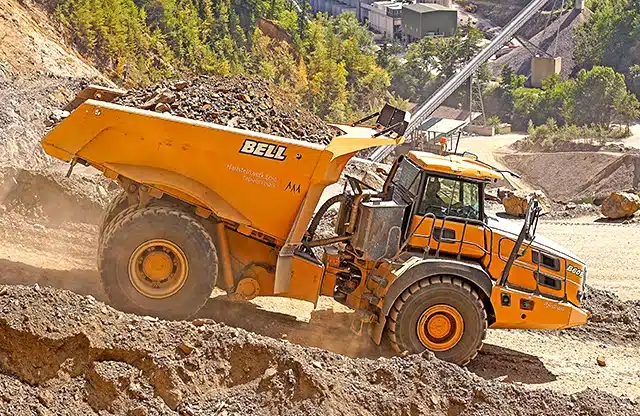
“Consequently, the UK has the largest population of Bell B20E ADTs in the world. The famous HS2 rail project, even though it has been scaled back to focus on the Phase 1 route between London and Birmingham, has been a major driver behind this growth. Clay miners and quarries supplying to this project have seen high demand for their products, and have found the Bell 4×4 ADT concept to be ideally suited and beneficial to their quarrying operations,” says Castle.
African market drivers
In Africa, where poor road infrastructure is the order of the day, customers generally find comfort in the 6×6 ADTs, which provide the versatility of being able to operate on both good and poor haul roads, reasons Castle.
“Whereas in the United States and Western Europe the demand for ADTs is construction-based rather than mining, it is the other way around in Africa. Commodity prices and political stability are probably the two biggest factors affecting demand on the continent,” says Castle.
There is strong demand for ADTs from mining countries in Africa, he adds, with South Africa being by far the largest market in 2025, followed by Côte d’Ivoire (Ivory Coast) and Ghana. While other African countries may only have double-digit sales figures, they have, in many instances, doubled their growth year-on-year, albeit from a low base.
While a large portion of Bell ADTs sold in South Africa are deployed in coal mining, both Côte d’Ivoire and Ghana are predominantly driven by the thriving gold mining sector, with the commodity currently enjoying exceptionally strong demand globally. After the gold price bottomed out in 2015 and 2016, notes Castle, the spot gold price has been steadily soaring and is currently trading at over US$5 000 per ounce. As a result, new mining licences have been awarded to start-up mines in Africa, which require new equipment.
“Our West African dealer has seen significant growth due to increasing mining activity, and we expect this demand to continue due to the drive for electric vehicle development and the growing focus on net zero carbon emissions. The latter creates demand for commodities such as copper, nickel, lithium and manganese, amongst others,” explains Castle.
Machine utilisation in Africa, he adds, is significantly higher than in the United States and Western Europe. As a result, ADTs in Africa are running more hours in a month than those operating in the Northern Hemisphere.
“To provide context, we base ADTs in Africa at around 500 hours per month, whereas the United States and Western Europe are around 100 hours per month. This high utilisation drives machine replacement cycles in markets such as South Africa, while other markets, such as Zambia, often opt to repower their machines for a second or even third life,” explains Castle.
On the product front
On the product front, in Bell Equipment’s experience, sales of the larger sized ADTs are driving demand in Africa due to mining and the economies of scale that operating larger ADTs offers – being able to transport a higher payload for marginally more fuel, and with fewer operators required per tonne of material moved.
“If we take South Africa, for example, large ADTs accounted for over 60% of our sales in 2025. In the United States, 54% of Bell ADTs sold into the market were large machines due to high-volume infrastructure and mining projects, as well as the reduced cost-per-tonne that large ADTs are renowned for on these types of projects,” explains Castle.
In Europe, he adds, small trucks are driving demand and represented about 65% of Bell Equipment’s sales last year. Likely reasons for this are that the European market prioritises fuel efficiency, manoeuvrability and versatility. Castle finds that worksites are generally narrower and more restrictive, making them better suited for smaller ADTs, which tend to be nimbler.
Key trends
One of the major trends shaping the ADT market, notes Castle, is the intense safety drive in the mining sector, which is primarily motivated by a ‘zero harm’ philosophy – a commitment to ensuring that every worker returns home safely every day.
This is particularly the case in South Africa. As of December 21, 2022, South African mines are required to implement Level 9 Proximity Detection Systems (PDS) / Collision Avoidance Systems (CAS) on all trackless mobile machinery (TMM).
Level 9 signifies automatic intervention, where the system can take control to stop or slow a vehicle if the operator fails to respond to a warning. In response to these legislative requirements, Bell was the first original equipment manufacturer (OEM) to offer Level 9 PDS- and CAS-ready ADTs in the market.
“Since then, the focus on mine safety has resulted in greater interest in fully remote-controlled, supervised autonomous and complete autonomous solutions globally. Our E-series ADT range has an advanced technology platform that is PDS-ready and autonomous-ready. With a technology agnostic approach, we can work with numerous service providers to offer customers solutions that meet their requirements,” he says.
Bell Equipment has already successfully integrated with several different systems through offering a combination of adaptable hardware, simulation tools, and shared testing facilities to service providers so that they can support customers that are implementing third-party technologies.
The International Organisation for Standardisation gateway, designed and produced by Bell, can be retrofitted to current and older-generation ADTs to provide a controller area network interface for system control. Installations can be easily completed on site at customer operations.
PDS and autonomous solution suppliers can also develop and test solutions virtually before integrating with a Bell ADT, using a detection system and vehicle system that the company has developed – this can run on a standard laptop or personal computer. This enables suppliers to connect their systems directly with the Bell systems, allowing for collaboration between the engineers throughout the new product testing process.
In addition, Bell is seeing greater use of telematics as a fleet management tool. Its advanced ADT platform has access to the Bell Fleetm@tic® telematics system, which is provided as a standard feature. This gives fleet owners and operations managers a complete picture of their machine health and productivity from one user-friendly interface.
“The simplicity and accessibility of Fleetm@tic® is a game changer. Customers have a secure login and password, which enables them to monitor their machines from anywhere at any time, and they can generate reports that can be set to arrive daily, weekly or monthly. It is a highly effective tool to identify bottlenecks, balance workloads and schedule proactive maintenance to minimise unplanned downtime,” says Castle.
In terms of safety, Fleetm@tic® provides real-time tracking of a machine’s location, speed and operating status. For asset management, geofencing enables owners to set safe zones, speed limits and prohibit tipping in hazardous or prohibited areas. Alerts are automatically issued for fault codes, unsafe tipping and driving violations.
Productivity of Bell ADTs is tracked by monitoring metrics including laden and unladen cycles, payloads and fuel burn.
“There is also a heightened environmental awareness around zero carbon emissions and alternative fuels. Part of our design philosophy has always focused on low fuel burn, and we are keeping our machine development in line with current and future market requirements for alternate fuels, including hydrotreated vegetable oil (HVO),” says Castle.
Positive outlook
Commenting on the outlook of the ADT market, Castle says “stable is a word that comes to mind, with growth in pockets”. The United States, he says, is the largest ADT market in the world, and its implementation of trade tariffs is likely to influence the market.
“Only two OEMs manufacture in the United States, with the majority manufacturing in Western Europe, including Bell Equipment, which supplies the market from our factory in Germany. It is improbable that the two US-based OEMs will have the capacity to meet the demand, which may create a market for used equipment, or we might see companies choosing to run their equipment for longer periods,” concludes Castle.