Situated in South Africa’s northernmost Limpopo Province, the well-forested region of Modjadjiskloof – home to the Balobedu people and the legendary Rain Queen Modjadji – is where Khulani Timbers operates. The company employs over 160 individuals; all deeply engaged in the production of high-quality timber poles.
Khulani Timbers traces its origins back to 1980, when Douglas Tullis established Harmony Sawmills. In 1991, his son, Mark Tullis, assumed leadership of the business, marking the beginning of Khulani Timber Industries as it is known today.
“We manufacture treated poles in accordance with SANS specifications and are proud to maintain the ACT (African Certification and Testing) mark,” says Mark. “This certification reflects our ongoing commitment to quality and service. Our workforce of 165 employees includes a diverse leadership structure that reflects South Africa’s demographics, with a strong emphasis on the inclusion of women.”
The company sources Eucalyptus timber locally, as well as from regions such as Makhado and Mbombela. While Eskom historically accounted for the majority of Khulani’s utility pole demand, a strategic decision in 2014 to diversify markets proved highly successful. The company initially expanded into the neighbouring countries of Botswana, Namibia, and Mozambique, and has since grown its export footprint across Africa, as well as into New Zealand and the Middle East.
“Our primary production consists of creosote-treated poles, with approximately 15% treated with Tanalith,” explains Leon Tullis, General Manager. “Around 60% of our creosote poles are supplied to power utilities. We also place significant emphasis on skills development, offering annual refresher training through our in-house training centre, which also supports community upliftment initiatives.”
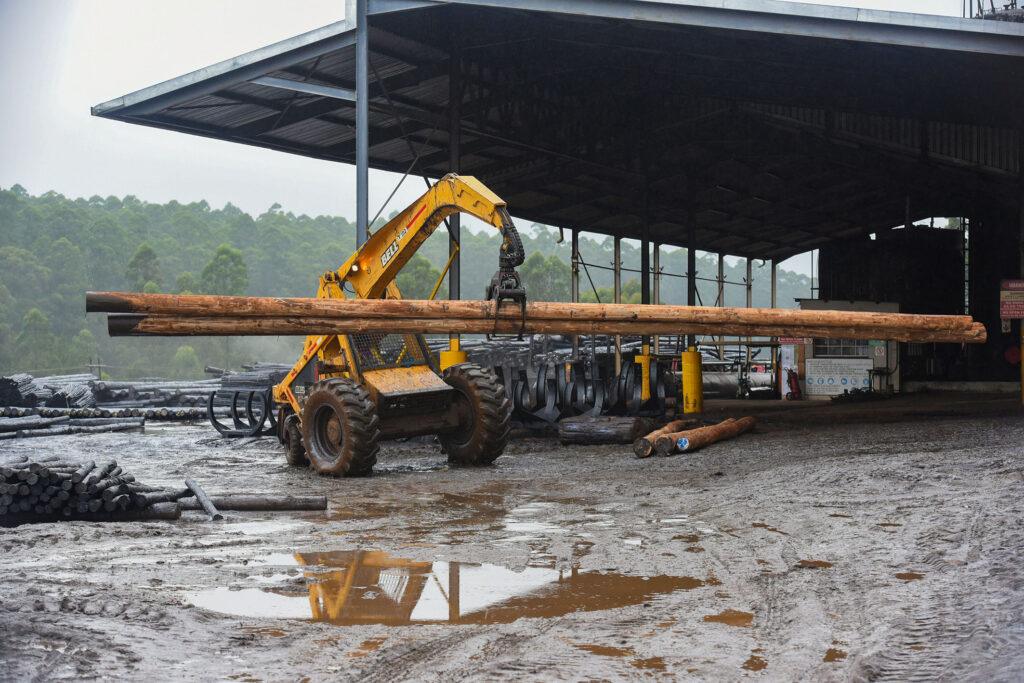
A key aspect of Khulani Timbers’ operations is the extensive handling process of timber poles. Mark reflects on the company’s longstanding relationship with Bell Equipment: “From the outset my father recognised the value of Bell Loggers. Our early machines included the Bell 120 models, which featured tubular frames, unlike the square-frame designs used today.”
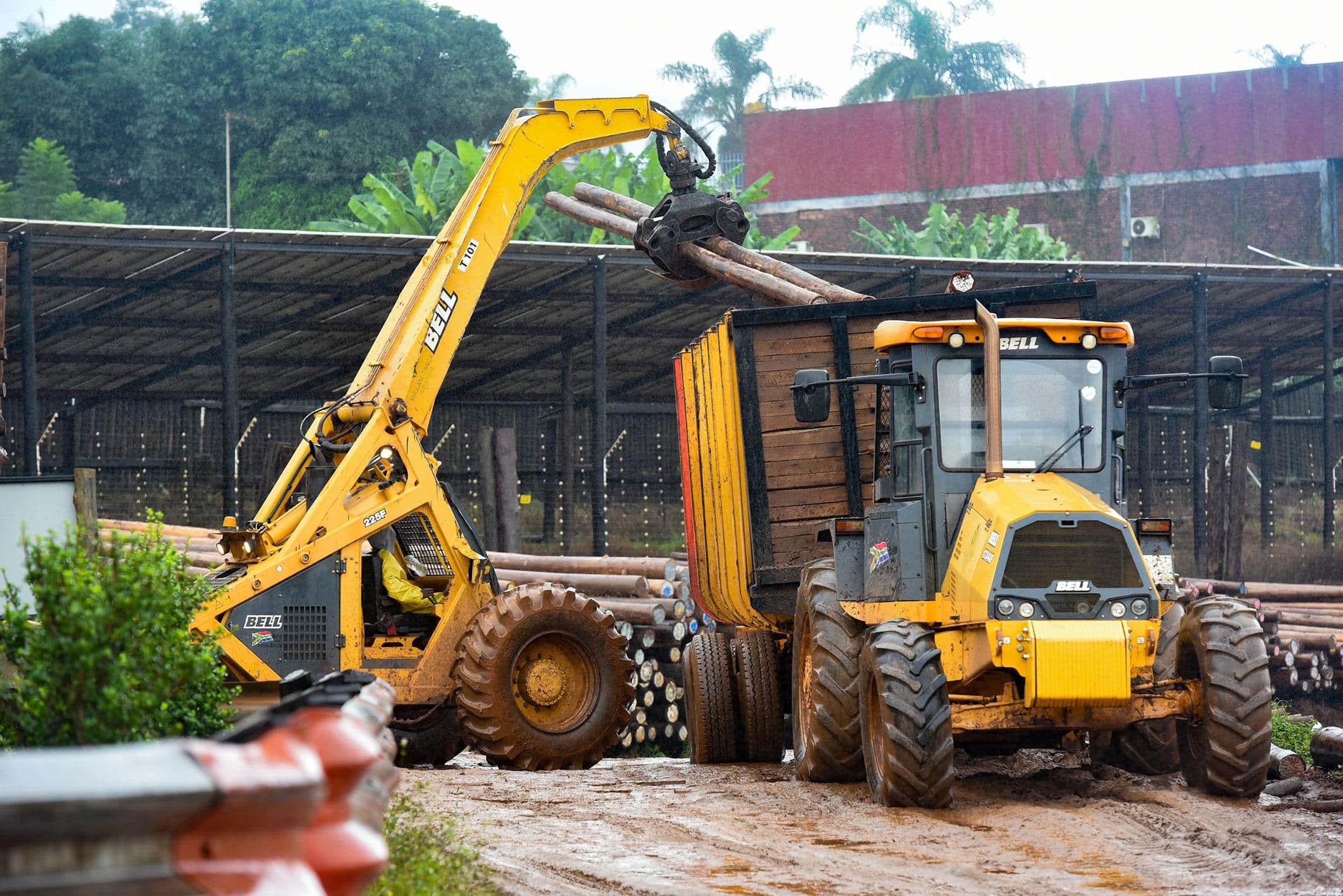
Over the years, Khulani has worked closely with Bell Equipment, even operating tracked loggers and providing valuable performance feedback. Today, Bell Loggers are integral to every stage of operations, from infield harvesting and depot handling to plant processing and export logistics.
Within the timber yard, these machines perform a continuous cycle of tasks, including offloading, stacking, and loading poles onto gurneys for treatment processes such as creosote and Tanalith impregnation. Notably, Khulani Timbers now operates the largest Tanalith treatment vessel in South Africa, following a recent plant expansion.
“Our fleet has grown to 24 Bell Loggers, comprising 18 Bell 225A models and six of the newer Bell 225F units, with the latest additions delivered in April 2026,” says Leon. “The A-series machines have proven exceptionally durable – particularly the Deutz engines – while the F-series offers quieter operation and enhanced efficiency.”
He adds: “Bell Loggers truly form the backbone of our operations, supporting every stage from harvesting to final export handling.”
Maintenance remains a critical priority. Mark notes that his father instilled a disciplined approach to servicing: “He ensured that machines were serviced every 250 hours without exception. With advancements in engine technology and lubrication, service intervals have now extended to between 500 and 1 000 hours. Given that each machine averages around 250 operating hours per month, this has improved efficiency significantly.”
Khulani benefits from its proximity to Bell Equipment’s Tzaneen branch, supported by both skilled technicians and the company’s own fully equipped workshop staffed by five qualified mechanics. This ensures minimal downtime and reliable machine performance.
Like Bell Equipment, Khulani Timbers remains a family-run enterprise. Mark’s son Leon serves as General Manager, while his wife, Adelè, is the Sales Executive. Mark’s daughter, Jessica, manages long-haul transport operations, and her husband, Ruan Snyman, coordinates creosote supply logistics with his road tankers.
Beyond its logging fleet, Khulani has also demonstrated innovation in its equipment utilisation. A Bell B25D Articulated Dump Truck has been converted into a timber forwarder by replacing its bin with stanchions, and a Bell 1734AF Haulage Tractor is used for timber transport operations. There is also a Bell Forklift 225A that is used for loading palletised guardrail posts and spacer blocks and a Bell 315SG Backhoe Loader that is ideal for plant maintenance and expansions.